Bulbous, occasionally ominous, gumdrop-shaped clouds. Molten pink mountains fleeing the day’s last light. Surreal, sculpted forms vibrating with energy perhaps best described with the words of Hunter S. Thompson: that moment “on the edge of the desert when the drugs began to take hold.”
To call Taylor Crisp’s paintings simply trippy would do a disservice to the multitudes she packs within. Her day job in the film industry as a creative assistant imbues her work with a cinematic quality, but the Long Beach, California, artist does more than recreate tropes from the silver screen.
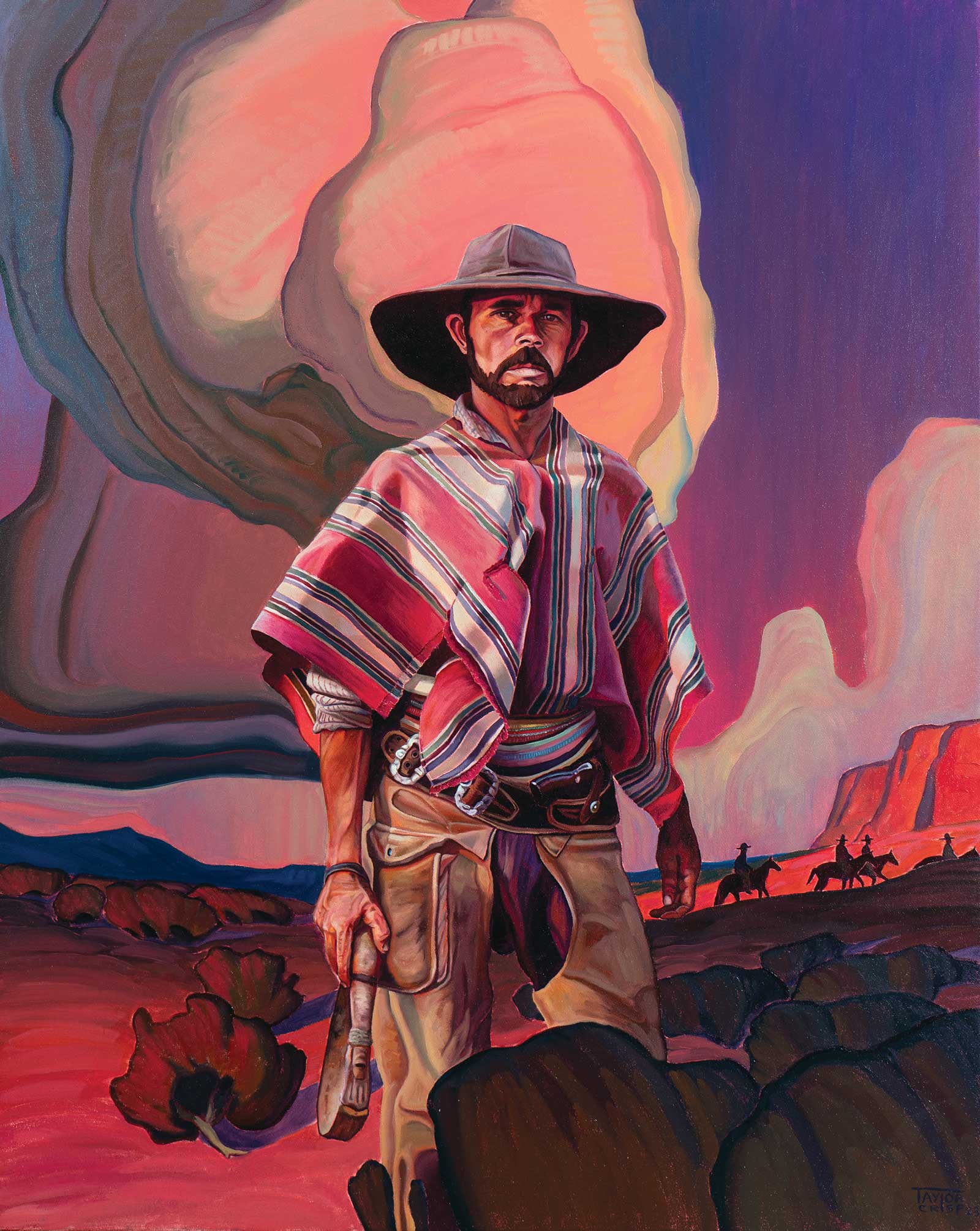
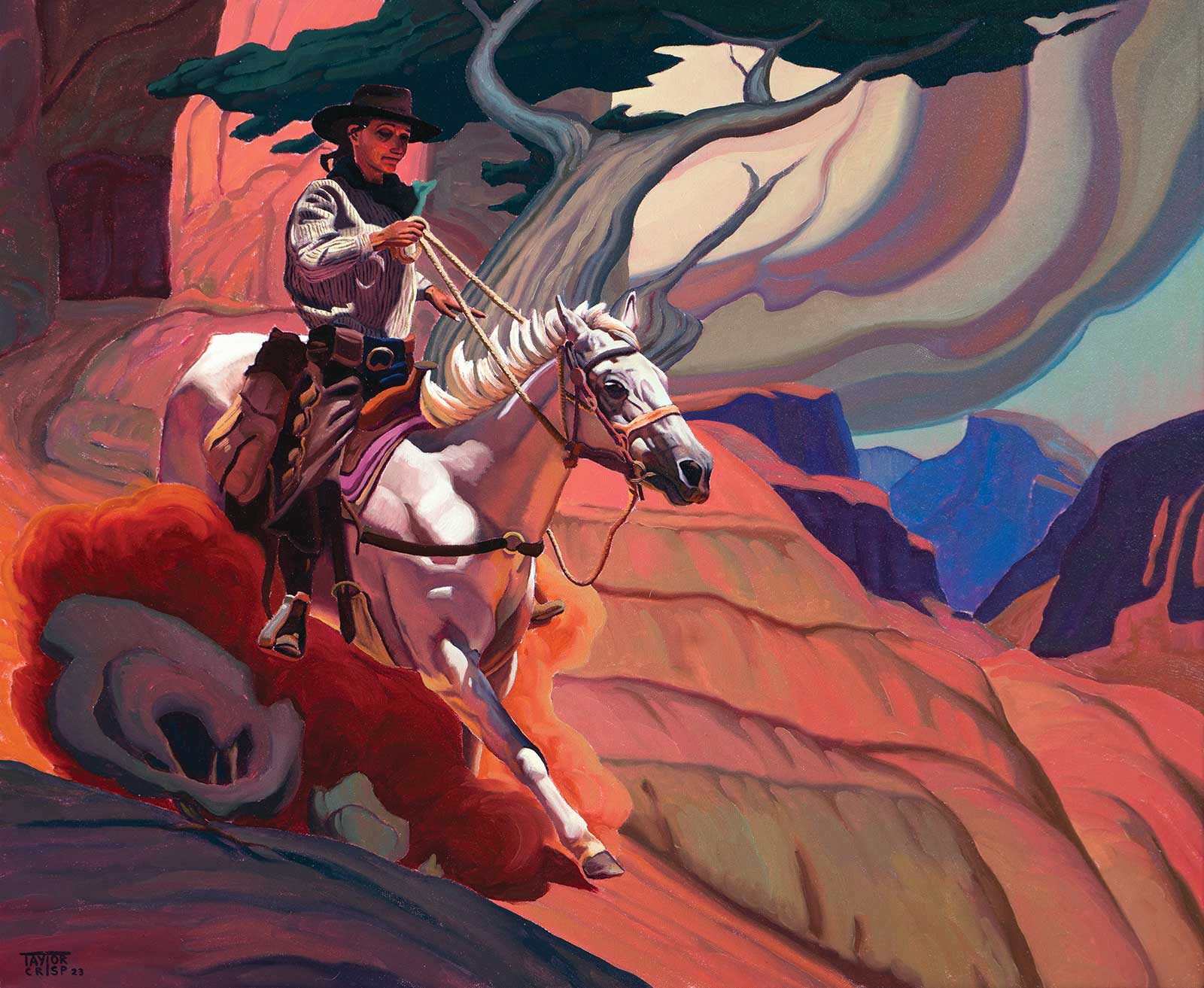
The Monolith, oil, 28 x 22 in. Courtesy Oh Be Joyful Gallery.
Originally from Craig, Colorado—midway between Steamboat Springs and Highway 40’s dinosaur country—Crisp’s interests meander from history, ecology and mining to fantasy and science fiction. During the pandemic, she dabbled in Dune-themed ceramics and resin-cast creatures. The art she collects is even more out there than the art she makes, Crisp says, citing a love for lowbrow culture, vinyl toys and Dungeons & Dragons. “Just the height of nerdom,” she laughs.
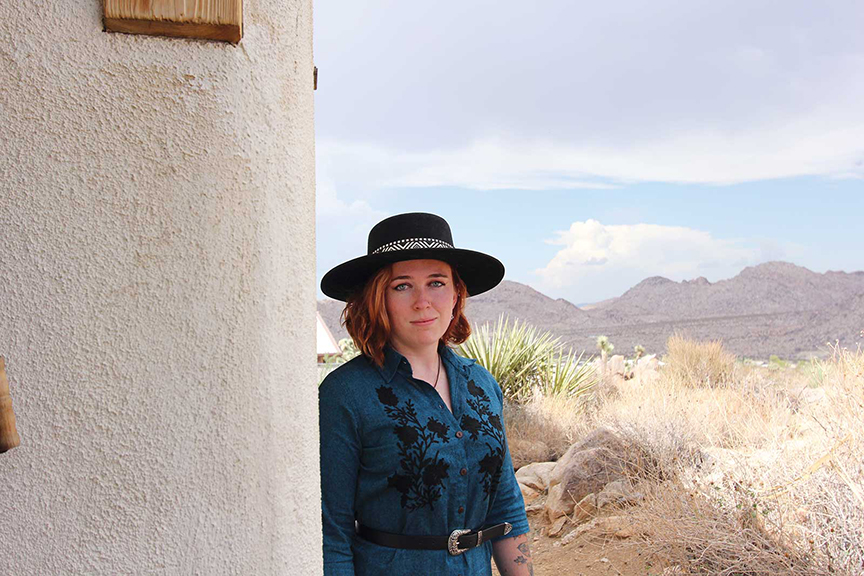
Taylor Crisp in the Southwest. Image courtesy the artist.
Tracy Schwartz, of Oh Be Joyful Gallery in Crested Butte, Colorado, notes Crisp’s penchant for skulls, bones and cemeteries. “Just like the truth of the West,” says Schwartz, “it depicts death and hardship versus all the fanciful, glorified things that you see over the years that aren’t exactly what the true West was like,” she says. Schwartz and gallery owner Nicholas Reti both mention Crisp’s inclusive reappraisal of Western mythology, spotlighting heroes and heroines from many cultures.
“Every one of her compositions, it’s either a story being told or it’s as if something could just walk into the canvas and start telling a story,” says Reti. “The set has been all designed and ready for the narrative to happen.” In addition to a solo show this summer, Crisp’s work will be part of a moon-themed exhibition at Oh Be Joyful in February, perhaps an opportunity for the artist to showcase her “dark side,” as Schwartz calls it.
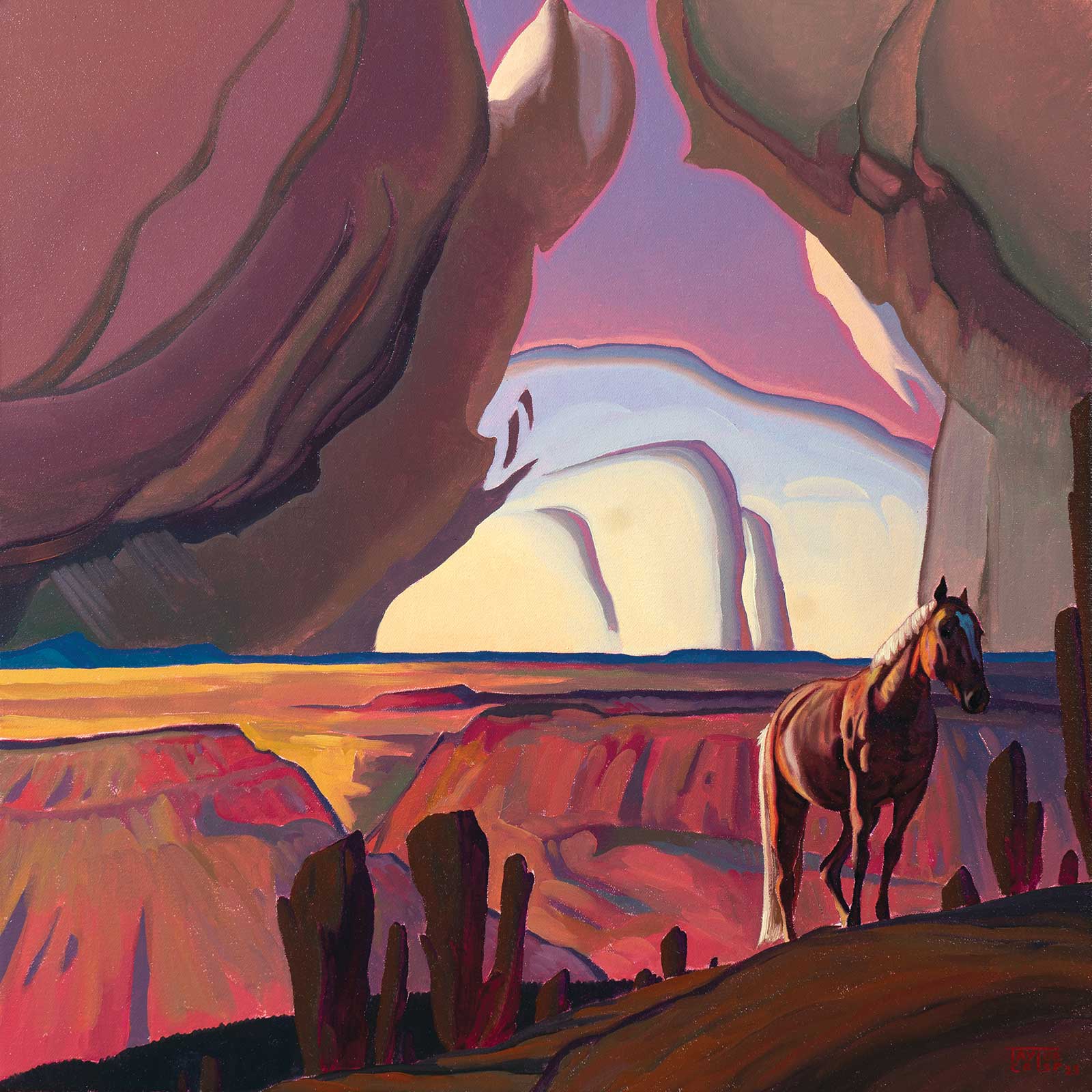
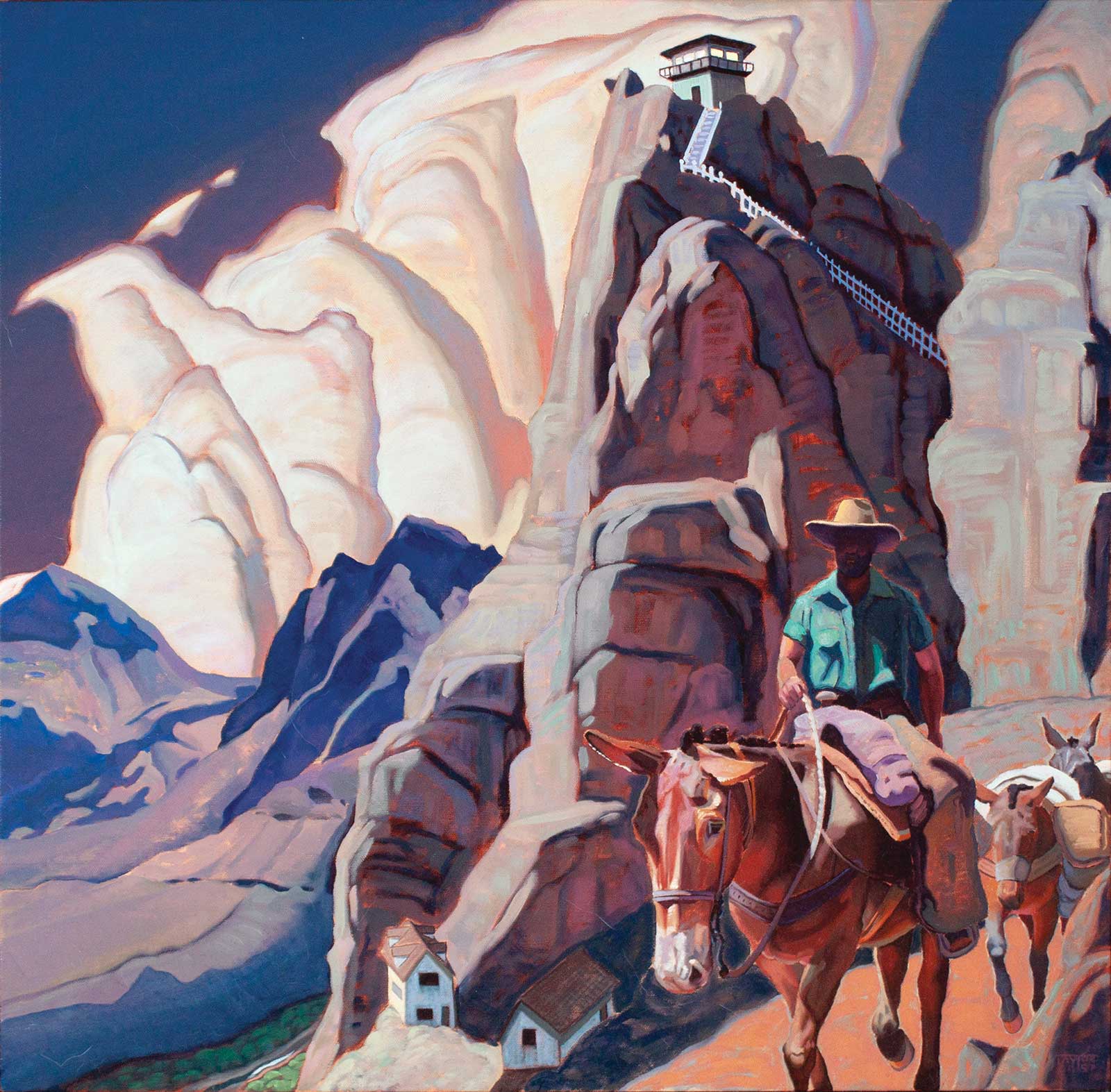
High on Black Mesa, oil, 20 x 20 in. Courtesy Oh Be Joyful Gallery.
For the Southern California artist, there’s no shortage of inspiration—not only in the film industry, but in the variety of local museums. Her favorites include the Hilbert Museum in Orange County, noted for its focus on California regionalists and Hollywood studio artists and animators, and the Autry Museum of the American West in Griffith Park. Another standout is the new Cheech Marin Center for Chicano Art & Culture in Riverside. “It’s doing exactly what a museum should do—showing the community itself as a mirror, like this is who we are, this is how we feel about where we live in this basin that’s called Los Angeles,” Crisp says.
While she has no formal training as a painter, Crisp’s study of historical artists and visual narrative in film means a viewer on the hunt for symbolism or allegory might find it in her work. Even Crisp’s clouds and horses can act as a stand-in for human experience.
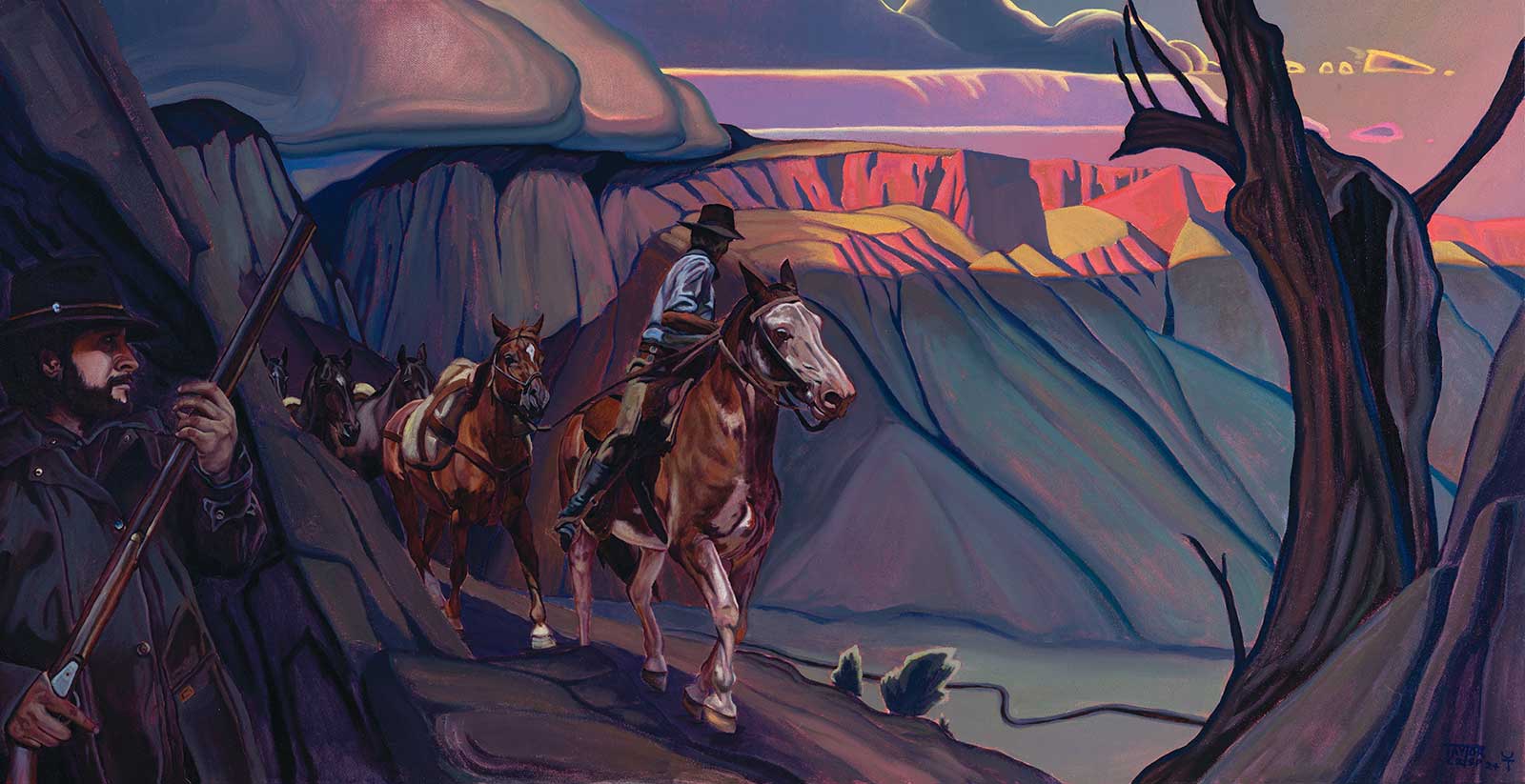
The Hunger — An Occurrence at Creede, CO, oil, 18 x 36 in. Courtesy Oh Be Joyful Gallery.
A Coloradan who worked at UCLA, collector Dennis Bitterlich found a connection between Crisp and his own biography, though “she ended up at the wrong school,” a playful jab at his cross-town rival, USC, where Crisp studied film production. “Not quite Ed Mell, not quite Josh Gibson,” Bitterlich says of Crisp’s painting style.
He and his late wife, Ciaran Trace, acquired a work by Crisp after attending an event at Western Gallery in Austin, Texas. The couple began their collecting journey with equal parts romance and practicality, Bitterlich explains. For Trace, who had a memory condition called aphantasia, buying artwork on trips was a tangible way to remember their experiences once they were back home. Paintings are “so much more colorful than cellphone pictures even,” Bitterlich says. “It really is fulfilling being able to see the textures and all the different colors and how the paint flows.”
While Bitterlich and Trace were initially drawn to Crisp’s painting A Cry in the Darkfor its color palette and subject matter of a nocturne of a horse against an adobe building, after Trace’s passing the title and the longing in the horse’s gesture came to mean something more personal to Bitterlich.
Down the Wash, oil, 20 x 24 in. Courtesy Oh Be Joyful Gallery.
“Visually striking,” “emotionally resonant,” and “ethereal, yet grounded” are words Manitou Galleries director Cyndi Hall uses to describe Crisp’s work. “Her mastery of color and form, combined with an undercurrent of narrative depth, makes her work stand out,” says Hall, who was eager to collaborate and showcase her art after following Crisp on Instagram and an “enthusiastic endorsement” from gallery star Kim Wiggins.
Like Wiggins, Crisp dives headlong into full saturation, tossing traditional color-value relationships aside in the name of a rich, moody, active canvas. Crisp’s use of intense pink, lavender, coral and blue also set her apart from the sandstone painters of the Southwest. “The color is more like when you’re half remembering something in a dream that’s very vibrant and you remember the emotions of the colors—if that makes sense—more than what it actually looked like in real life, or what you could capture in a photo,” says Crisp.
Into Thin Air, oil, 24 x 24 in. Courtesy Oh Be Joyful Gallery.
Her process often starts with grainy, lo-fi reference photos taken on road trips between Colorado and California. Utah has some of the “most insane landscapes in the world,” she says, and even her “terrible” photos help record landforms and light effects. “Then I will work out little thumbnails and color ideas and be like, this was the feeling I wanted to capture as I was driving through Canyonlands.” Next, she pulls together reference photos of figures and horses in action to create a final composition, leaving room for play and change within the background as she goes, resulting in a forced three dimensionality that calls to mind dioramas or an artificially lit film set.
“That’s really intentional,” Crisp says. “I also have a painting I did during Covid, which is explicitly a diorama of a Western scene with two people looking at it.” That work, Inside Looking In, was part of a pandemic-themed show at Santa Paula Museum in 2021. Further up the California coast, Crisp was included in a 2019 show celebrating public lands at the California Nature Art Museum, formerly the Wildling Museum, and her 2023 presentation at SLOPOKEwon best of show.
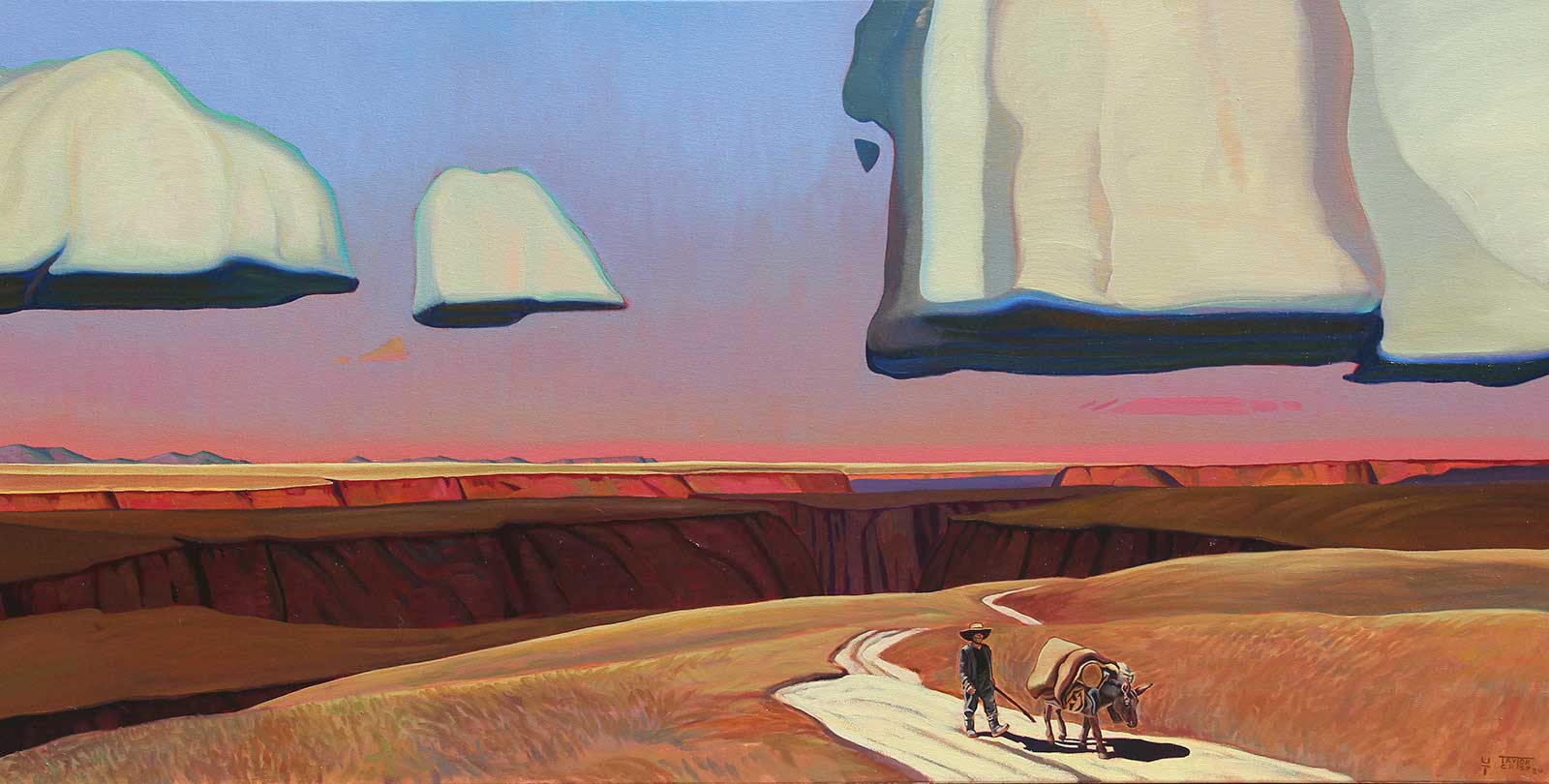
Market Day, oil, 24 x 48 in. Courtesy Manitou Galleries.
While the young painter’s trajectory might feel fast to those just getting to know her work, Crisp first reached out to Oh Be Joyful in 2018. They started working together in late 2021. Since then, they’ve placed around three dozen works with collectors, many by draw “to give people a fair shot,” Schwartz says. The gallery had just started exploring the contemporary Western genre, wondering if their audience would respond to Crisp’s adventurous take on the West. “I noticed a real broad interest from some of our best collectors that have deep collections, all the way down to even engaging the newest, youngest collectors,” says Reti. Schwartz adds, “Yeah, like absolute first-time buyers.”
“She really is touching on subject and colors and graphic—I think a modernization of the story of the West,” Reti continues. “Whereas there are some nods to other artists or historical artists, she really is doing something that is her own and has her own distinct voice.”
Over at Manitou, Hall has also had tremendous success with Crisp’s work. “Since we began working with Taylor, her artistic practice has grown significantly,” Hall says. “She has become more comfortable as an artist, allowing her cinematic arts background to shine through her work. Taylor is open about her influences, often discussing how the works of Ed Mell and Maynard Dixon inspire her own creations. This transparency and willingness to explore her artistic roots have enriched her pieces, showing a maturity and depth that continues to impress us.”
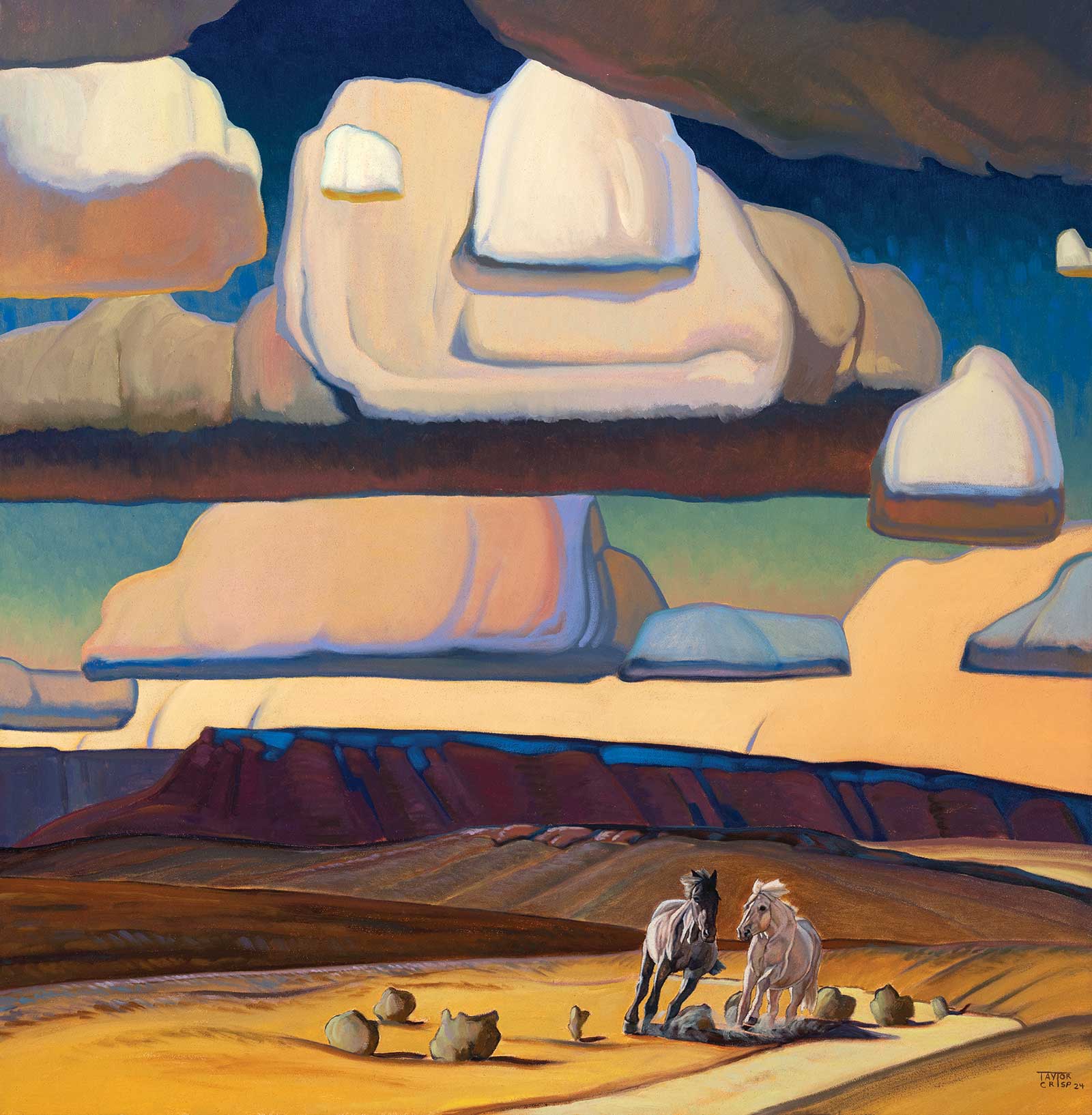
Prismatic Clouds, oil, 24 x 24 in. Courtesy Oh Be Joyful Gallery.
As for future goals, Crisp would love to get more involved in public art—a mural in a tiny post office somewhere, WPA style. And if a career in film and a thriving art practice weren’t enough to keep her busy, Crisp has another side project: searching for a lost Maynard Dixon mural. “It probably was destroyed, but I just had this dream of finding it rolled up in a basement somewhere,” Crisp says of Dixon’s 1930s mural at John C. Fremont High School. In her free time, she scours the LA Unified School District archives and online newspaper clippings in search of clues to its whereabouts. “Very citizen detective,” she laughs. No leads yet, but her hunt continues. “It’s just really exciting, like a Dan Brown-style mystery that I think I will solve someday,” she says. “Yeah, so I’m just obsessed.”
While the Maynard Dixon mystery is still being written, Crisp’s own story is well underway. Look back over the past few years and you’ll see she’s finding her line as an artist, galvanizing a style that’s gaining a following and quickly recognized as her own. From online shows to drawbox-worthy demand, Taylor Crisp has entered the scene. It should be fun to see where she takes it in Act II. —
Powered by Froala Editor


